Selected works›Australian Popular Science Feature
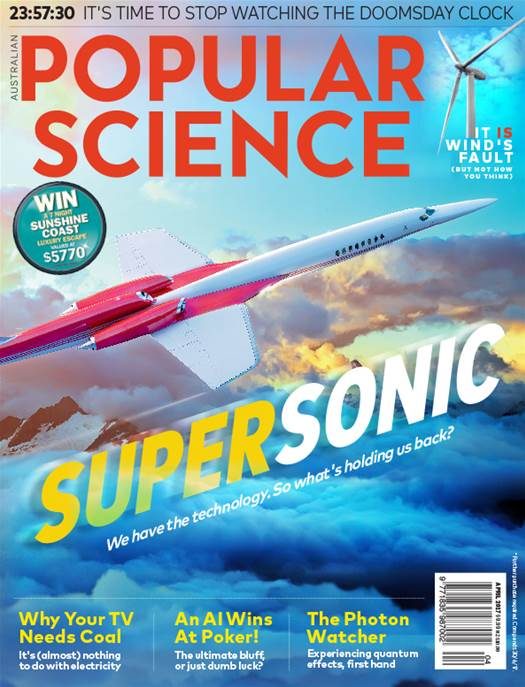
Beyond the Boom
Your laptop, smartphone, car, even your camera: all these everyday technologies have become faster and more powerful with every new model. But international air travel is an exception. Journey times have barely changed since the 1990sSince I wrote this in 2017, some trips from Australia have got a little quicker, but only where a new nonstop route cut out the stopover. Perth to London nonstop (from 2018) takes about 17 hours instead of about 20, and Melbourne to Dallas nonstop (from 2022) about 17 and a half instead of about 20: roughly 15 per cent faster. Sydney to New York via Auckland saves less than 10 per cent. Sydney to London still takes about 22 hours, as it did in 2017, until Qantas starts flying it nonstop in October 2027. The planes cruise no faster than they did in the 1990s. The time saved is the stop on the ground., yet supersonic military aircraft are common. So what happened to the dream of supersonic travel? Do we still want it? And more importantly, do we need it?
The history of commercial airliners – where non-aviators pay professionals to fly them somewhere, according to a schedule – is surprisingly short. Consider that the first ever “passenger airline service” was a 23 minute flying boat trip from St Petersburg, Florida to Tampa, on the first day of 1914. The flight carried one passenger, was kind of a stunt if we’re honest, and the “scheduled route” only lasted four months.
Real airline service in Australia, like we would recognise it, with planes landing on proper runways and operating all year, began in December 1921, when Western Australian Airways started its scheduled run from Geraldton to Derby. Qantas followed in November 1922, flying from Charleville to Cloncurry in outback Queensland. In America it took until 1926, when Mr Ben F Redman, of Salt Lake City, Utah, and fellow passenger J A Tomlinson travelled from Salt Lake to Los Angeles, via Las Vegas, at a maximum speed of 209 km/h, and a maximum altitude of 12,000 feet (3,658m). Not counting the stopover in Vegas, their total flight time was eight hours. They sat on the mail bags and paid $90 ($1,200 today) each for the privilege.
Yet just over 50 years later, in 1977, well-to-do passengers could travel between New York and London at supersonic speeds, taking just three and a half hours to make the journey.
From chuggy little radial prop engines to incredible jet turbines capable of astonishing speed, in just 50 years. Humans, it seems, are destined to travel by air.
Then of course, it all went wrong. Already struggling to maintain profitability in a cutthroat industry, Concorde’s operators balked at rising maintenance costs following 9/11. On top of that, the super-rich became (somewhat justifiably) wary of flying, and the premium-first-class market all but disappeared.
All this came on top of a terrible accident – albeit Concorde’s only fatal crash – in July 2000, when an Air France aircraft hit debris on the runway at Paris Charles de Gaulle.
Since the end of Concorde flights, and the even earlier failure of the USSR’s Tupolev Tu-144 SST, armchair critics (and a few highly qualified experts too) have dismissed supersonic transports as economically foolish. Concorde, they say, should never have flown.
Not In It For the Money
Commercial airlines are odd businesses. Capitalism made the Boeing 747 and the Airbus A380 possible, but on the other hand, the costs of actually operating these heavier-than-air behemoths are huge. You need to be extremely clever to make real money as an airline.
So when it came to Concorde, buying an almost textbook-definition of “boondoggle” to fly 100 people across the Atlantic into a complex snare of anti-noise regulations and public resentment hardly counts as savvy. There’s no mystery why the only airlines to buy the thing had government backing.
The promise of an SST – it does the trip in half the time, so you should be able to do twice the trips – makes sense in theory. But once you add in anti-sonic-boom requirements, limited routes and complex technology, the promised doubling of flights never comes to pass.
Concorde was a great experience for its passengers. For its operators – British Airways and Air France – not so much. What really limited Concorde wasn’t the crash or terrorism. It was the way the plane wasn’t allowed to operate at supersonic speeds over land.
The sonic boom – where air first builds up in a series of colliding high-pressure waves in front of the aircraft and then collapses back into a low-pressure area immediately behind – has been part of popular culture for years now. YouTube videos of guys on aircraft carrier decks filming booming F-14s or F/A-18s doing supersonic flybys, are great fun to watch. But living under the flight path of a supersonic airliner would be a nightmare. Especially for the good china.
Earth’s atmosphere is well-suited to heavier-than-air flight. Thick enough to support a decent-sized wing, it allows humans to flit back and forth across the world at speeds of 1,000km/h or so without much trouble.
But above 1,200km/h (at sea level) lurks the sound barrier, the speed at which energy can propagate from molecule-to-molecule. Attempt to muscle through the atmosphere at speeds over 1,200km/h, and a pilot becomes painfully aware that the air is a physical thing which must be forced apart, pushed out of the way.
So invent an SST that doesn’t boom, right? Seems obvious. Engineers are clever people, and they have computers now to run detailed simulations. What’s the problem?
Well, until recently the problem was the market. The general public just wasn’t interested in getting to the other side of the planet twice as fast, if it meant paying three times the ticket price.
But there’s a new market now, that has arisen since the global financial crisis of 2008. The ultra rich.
User Pays... A Lot
Far from eliminating – or at least alleviating – inequality, the various collapses and corrections of the last decade seem to have accelerated the gulf between the ultra-rich and the rest of us. Supercars are out, HYPERcars are the thing now. Mega yachts, diamond-studded smartphones, these people have billions and are looking for something to spend it on.
In the wake (in two senses of the word) of government-subsidised SST transport, a number of smaller companies have popped up, promising to build not SST airliners, but SST business jets.
These smaller planes, carrying 12 to 30 people, can offer real benefits to their customers. To an energy oligarch, cutting four hours from the weekly flight to Dubai is worth the $100 million investment in an SST.
Pitched as the most luxurious, the most exclusive class of business jet, these smaller SSTs will be less troubled by noise regulation. Many will operate in China, where there are no rules about sonic booms over land. Yet.
Others, like some of the examples in this feature, will fly much faster than Concorde. This means having to drop down below supersonic speeds once they reach the US or Europe won’t be such a big disadvantage. The billionaires sipping cognac in the sumptuously-appointed executive cabin are still saving hours on their regular flights.
An SST is the ultimate expression of extreme wealth, if you think about it. Nothing says you’ve got the most points like spending a quarter of the price of an Airbus A380 on a plane that only seats 12.
On top of the cash-flashing boast factor though, many of the companies building (or at least, claiming they will soon be building) SSTs are taking advantage of cutting-edge research in wing and engine design.
These changes, building on work done by NASA, JAXA and others, will essentially work to divert air in such a way so that the boom will be, if not eliminated, then heavily suppressed.
Sonic booms have a distinctive “N-wave” pressure topography. By disrupting the N, smoothing a small number of large shock-waves into a series of smaller waves, the distinctive “ka-POW” of the boom could become little more than a rumble. Hey listen you poors: jet planes make noise, okay? What are you gonna do about it?
From Dreams Of Speed...
If you yourself are not in the immediate market for a $100 million middle-finger to both the rest of society and some of the laws (well, bylaws really) of physics, take heart.
What’s clear from our research into this article is that it’s very easy to create a CGI render, or even build a small wind-tunnel model of a business jet SST. Then give it a snazzy name (usually some kind of play on QueSST, from NASA’s ongoing Quiet Supersonic Technology project), a shiny logo, and build a webpage.
Real anti-boom SST research is still the domain of Boeing, Lockheed Martin, NASA and other organisations which can play a long game with little regard for immediate returns.
Companies and corporations with a history of actually building and delivering real planes, all slate their SST projects for the late 2030s. Some of the more sensible-seeming smaller builders, including Boom Technology, have more realistic ambitions.
Boom is an interesting example, and not just because Richard Branson’s Virgin Galactic holds “options” for 10 of whatever aircraft the company will eventually build.
It’s interesting because the Boom XB-1 – nicknamed the Baby Boom – is a small-scale “demonstrator” that could fly as early as 2018. Crucially, it doesn’t attempt to mitigate its sonic boom or break Concorde’s existing speed records – Mach 2.2 (2,715km/h) is plenty thank you very much. And it can fly using existing engines: the General Electric J85-21, a proven 80s-era turbojet.
Of course, scaling that up to a 50-seater three-engine passenger jet is more of a challenge. There’s no powerplant capable of powering such an aircraft, except for military engines which are infamously not reliable enough for economical commercial use.
Similarly semi-realistic is the Aerion AS2, a likewise three-engined, but only 12-seater business jet. It won’t try to smash speed records either, hitting only Mach 1.5 (1,852km/h) and using new research on laminar flow at supersonic speeds to improve fuel economy.
Interestingly, Aerion says it moved to a three-engine design because of “noise regulations”, while Boom Technology says a trijet frees its larger aircraft from ETOPS limits. ETOPS rules keep twin-engined aircraft to routes where it would take up to 180 minutes to fly to an alternate airport on a single remaining engine, in the event of an engine failure.
... To Flights of Fancy
Whatever the reason for their designs, at least Boom Technology and Aerion seem to be operating in the realm of the possible. All it could take to make their SSTs a reality is an injection of funds, and someone willing to develop a super-reliable, supersonic-capable turbojet engine on the strength of a couple of dozen maybe-orders.
Meanwhile, other companies are more ambitious. After all, why stop at supersonic when you can go HYPERSONIC! Hypersonic is any speed over Mach 5 (6,174km/h) and it brings with it a whole new set of engineering challenges.
From outer surface heating to weird aerodynamic effects, hypersonics are currently the domain of actual space rockets and extremely expensive military unmanned testbeds.
Even projects like the HyperMach HyperStar only flirt with hypersonics, promising a top speed of Mach 4 (4,939km/h). It will use to-be-invented electric engines and a totally plausible sounding electromagnetic drag reduction technology to alleviate the boom.
It’s easy to make fun of these hugely ambitious, 30-40 years-in-the-future projects. And perhaps the startups who put out glossy renders and breathless paragraphs about what it was like when men first walked on the moon, won’t even deliver actual aircraft.
But pushing atmospheric flight to the absolute limit remains a serious project, and the passion of aerospace engineers around the world. Sure, when DARPA tried to test fly a hypersonic drone, it tore off its own skin in the process. But that’s just a setback.
Meanwhile, it seems extremely likely that by 2030, the ultra-rich could indeed be jetting around at supersonic speeds, while the rest of us crawl across the face of the planet, like tiny (flying) ants barely capable of cracking 1,000km/h with a tail wind...
...which is actually still incredible. Perhaps, for SSTs, that’s the biggest challenge of all. Right now, you can get to London from Sydney in less than 24 hoursSince this was written, travel times have dropped a little, but only where a route went nonstop: Perth to London, nonstop since 2018, is about 15 per cent quicker. Sydney to London still takes about 22 hours with one stop, until Qantas starts flying it nonstop in October 2027.. And it doesn’t even cost that much, not really. For that kind of journey, will saving half a day ever be worth the cost?
If we’re being honest, Concorde was never much more than a carnival ride, a fun thing to do to qualify for a certificate you could show your friends. Does the world NEED supersonic transport?
We say skip the whole thing and go straight to sub-orbital ballistic flights. Why spend 10 hours getting to London when you could do it in two?
Face it. Until we hit that famous light-speed barrier, we’ll always want to go faster. All we need is the maths, and the cash.
Back to the portfolio